
COOP
DAI's MA in Art Praxis study trajectory offers 4 distinctive curriculum components.
All students are required to take part in all 4 of them:
1. COOP study groups = introduced below
2. How To Do Things With Theory
COOP ~ formal framework 2024-2025:
COOP study groups ~ formal framework
COO ~ curatorial framework 2024-2025:
COOP study groups, are at the heart of the DAI's program. Past COOP study groups are archived under CONTINUUM: Chrono~archive
COOP education leader 2024-2025 is Philippa Driest; in charge of the management of all productional and formal aspects of this curriculum component. For the academic year 2024-2025 students and tutors direct all their questions in regard to the modus operandi of the COOPs to her.
DAI's partnership framework is developed by artistic director and head of program Gabriëlle Schleijpen. In the academic year 2024-2025 each member of the DAI’s student body will be able to join 1(one) out of 7 (seven) COOP study groups, activated by the following partnering institutions:
*Archive (Berlin, Dakar, Milan)
*Bulegoa z/b (Bilbao),
*Hosting Lands (Copenhagen),
*De Appel Amsterdam (Amsterdam)
*If I Can’t Dance I Don’t Want To Be Part Of Your Revolution (Amsterdam),
*Neringa Forest Architecture (Nida),
*SAVVY Contemporary (Berlin).
These seven excellent partners from the expanded field of contemporary art have all been invited because of their artistically headstrong and politically outspoken positioning as platforms for research and presentation. As an educational program with purpose, we are absolutely thrilled that they are willing to share their highly valued, precise knowledges, skills, experiences and networks with our community. In return upon DAI’s investment in each collaboration, we ask them to carefully curate tutorial teams with a compelling vision on study and non-extractive forms of research, while eager to collaborate with our student body.All COOPs acknowledge the hybrid nature of current praxis wherein roles can easily co-exist in one person or be swapped among the members of a collective or otherwise.
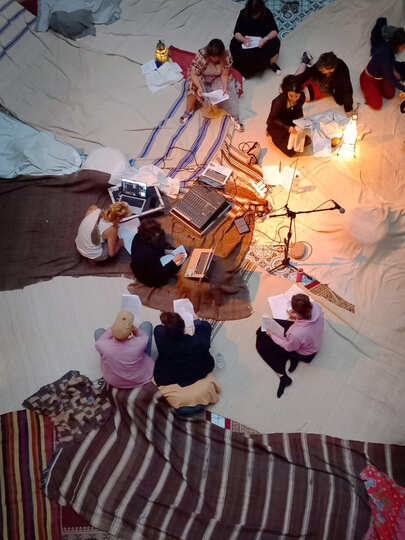
COOPs bring makers, researchers, writers, organizers and curators (be they students or tutors) together around well-defined, relevant questions and topics. All are called to active participation in these year-long curated, collaborative, un-disciplined, art research trajectories which are presented during the introduction week.
Over the course of one academic year every DAI-student will join one of the COOPs. Thus, during the two years of study at DAI a student participates in two different year-long COOP study group trajectories.
COOPs gather for several days during each DAI Confluence to share research and to develop a group work. Ideally this work comes into being as an entirely collaborative endeavour, but it may also be the umbrella for more or less individually produced works, imaginatively brought together by the study group.
Gatherings can take the form of a seminar, group presentation, workshop, reading group, walk, site visit, boot camp, laboratory, screening, interview, exhibition, ritual, meditation, party, work-out, exercise or otherwise.
Each COOP's modus operandi is guided by an overarching question or proposition to which all (so including the tutors) can respond with aural, visual, tactile, performative, digital, cinematographic, choreographic, architectural, curatorial, textual, theatrical, theoretical, and practical contributions (embedded within the framework created by the tutor team). Students can be asked to prepare and lead specific sessions.
The tutorial teams offer support to every student to help create meaningful connections between the student's praxis and the specific field of enquiry of the study group.
Students are asked to invest generous time, in-and outside DAI Confluences ( see the formal framework for the required number of hours). Next to artistic, theoretical, and curatorial vision, practical skills and knowledges will be of crucial importance to:
COOP SUMMIT 2025
What to expect from the COOP SUMMIT, our annual three-day assemblage of happenings, which has been taking place every year since 2018 ?
Click to find archived introductions and information.
CHRONICLES
CHRONICLES are containers, curated, moulded, sculpted and choreographed by the student participants in our COOP study groups. Here textual, visual and aural notes echo day to day encounters during the DAI's monthly study group gatherings. Taking shape by diverse forms and styles of mediation, they exist as fragmented, artistic and lively modes of archiving how knowledge was produced and shared; thus building a student led mnemonic reservoir of and for our fleeting community and beyond.